Comparison of Four Generations of Flow Cytometer Technology
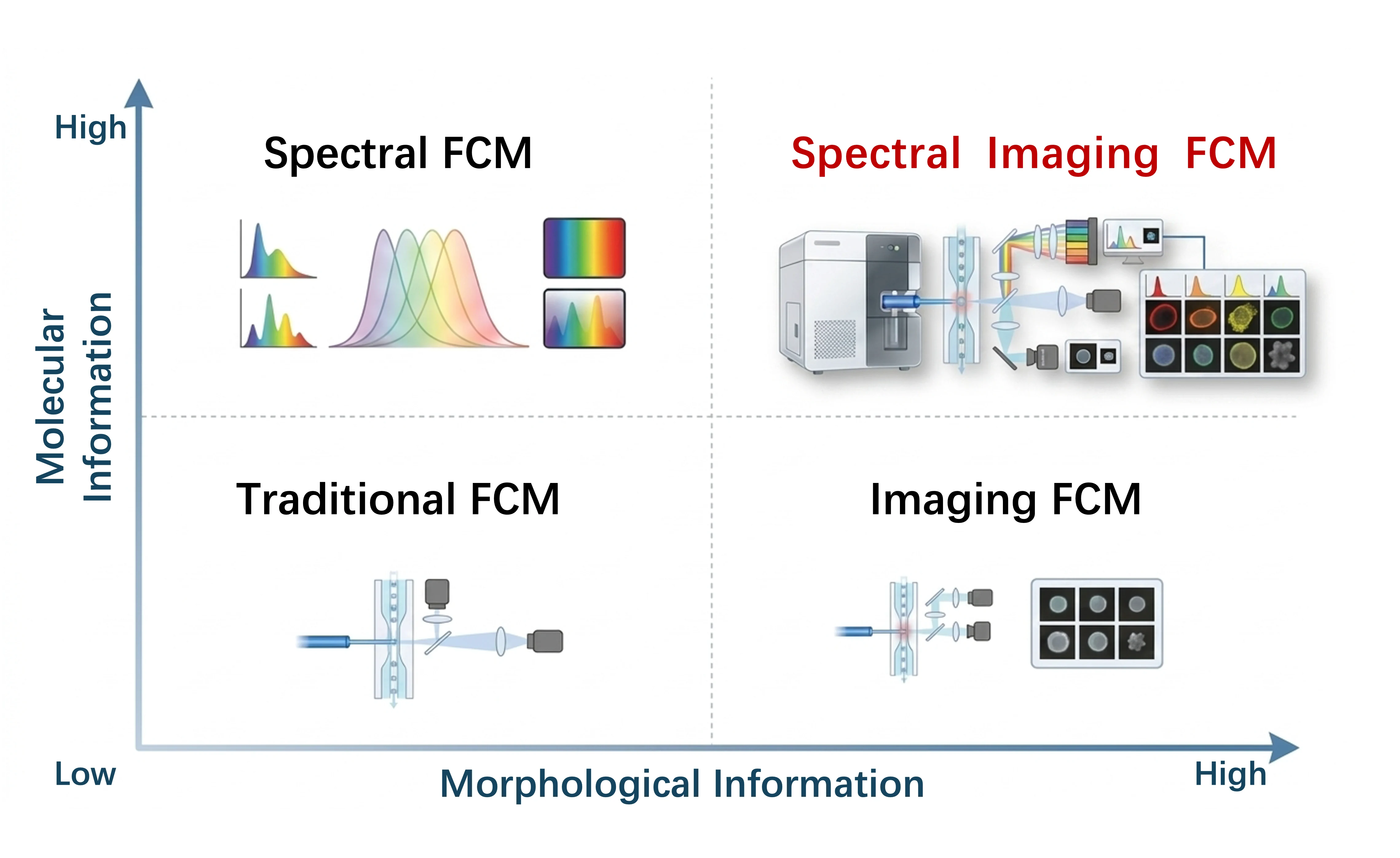
Phase I
Traditional Flow
Core Advantages
High throughput, accurate quantification, mature technology
Typical Applications
- Immunophenotyping
- Cell cycle
- Apoptosis detection
- Cell function analysis and routine testing
Phase II
Spectral Flow
Core Advantages
High-dimensional molecular analysis, complex spectral resolution, high sensitivity
Typical Applications
- Deep immunophenotyping
- Weak expression detection
- Autofluorescence removal
- Nanoparticle/Small Particle Analysis
Phase III
Imaging Flow
Core Advantages
Seeing is believing, bridging flow and microscopy platforms, strong statistical capability
Typical Applications
- Cell-cell interactions
- Subcellular localization
- Morphological classification
- Image Sorting, FISH, Rare Events, Imaging Hematology Analyzer
Now
Phase IV
Spectral Imaging Flow
Core Advantages
High-Dimensional Fusion of Molecular and Morphological Information
Typical Applications
- Compatible with all above scenarios, more flexible usage
- Suitable for life science research and clinical translation
- AI research and biological design tool development
Phase I
Traditional Flow
Core Advantages
High throughput, accurate quantification, mature technology
Typical Applications
- Immunophenotyping
- Cell cycle
- Apoptosis detection
- Cell function analysis and routine testing
1960s–2000s
Phase II
Spectral Flow
Core Advantages
High-dimensional molecular analysis, complex spectral resolution, high sensitivity
Typical Applications
- Deep immunophenotyping
- Weak expression detection
- Autofluorescence removal
- Nanoparticle/small particle analysis
2010s
Phase III
Imaging Flow
Core Advantages
Seeing is believing, bridging flow and microscopy platforms, strong statistical capability
Typical Applications
- Cell-cell interactions
- Subcellular localization
- Morphological classification
- Image sorting, FISH, rare events, imaging hematology analyzer
2010s–now
Now
Phase IV
Spectral Imaging Flow
Core Advantages
High-dimensional fusion of molecular and morphological information
Typical Applications
- Compatible with all above scenarios, more flexible usage
- Suitable for life science research and clinical translation
- AI research and biological design tool development
Fairy SI-5